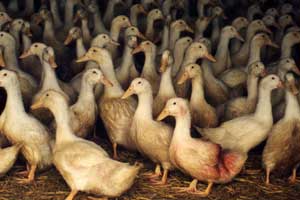
For efficient and productive duck breeding operation, consider the following tips recommended by experts from the Philippine Council for Agriculture and Resources Research in Los Banos, Laguna.
Procedure:
1. Maintain the proper ratio of male to female ducks in a breeding shed or kamalig. Put in one drake for every five to 10 female ducks. Keep extra drakes in a separate shed in case some male breeders die of diseases or become unproductive.
2. The drakes can be distinguished from the females by their voice and appearance. Females quack while drakes provide a hissing sound. Drakes have curly tail features.
3. If possible, the drakes should be one month older than the female ducks. This is to ensure that the males are ready for mating during the breeding season. 4. Choose drakes and females alike with well-developed bodies and good conformation. They should be healthy, have a good set of feathers and with keen, alert eyes. Do not select those that are obviously sickly and thin.
Source: elgu2.ncc.gov.ph, photo courtesy of http://www.factoryfarming.org.uk
1. Buy your breeding stock from reliable duck raisers. The Pateros duck (native duck) is good for egg production and the Peking duck is good both for meat and egg purposes. You can also raise Muscovy duck or Pato. Muscovy has low egg production but is more self sustaining than the Pateros and Peking ducks.
2. Build your duck house in a quite, cool place and near as possible to a stream or pond. Local materials like bamboo, nipa and cogon are cool and cheap. 3. Provide each duck with at least 34 square feet of floor space. The floor should be covered with either rice hulls, corn cobs, peanut hulls or similar materials to make it dry and clean; and to help prevent the spread of pests and diseases.
4. You can provide a swimming pond for the ducks if you wish. One of 10 feet wide and 20 feet long is adequate for 50 birds. However, a pond is not really necessary in duck raising. The ducks can lay just as many eggs without it.
5. Pateros ducks start laying when they are about 4-6 months old. Peking and Muscovy ducks start laying at about 6-7 months old. In breeding, you need male for every five female ducks. Select breeders that are healthy, vigorous and without defects.
6. Ducklings need to be brooded or warmed until they are a month old.
a. The temperature required for brooding is 95°F for the first week, 90°F for the second week, 85°F for the third week and 80°F for the last week.
b. The behavior of the ducklings is a good indicator whether brooding temperature is correct. The ducklings huddle close topether toward the source of heat when temperature is low; scattered or spread evenly when the temperature is correct; but planting and moving away from the source of heat when the temperature is too hot.
c. A good brooding area is at least 1/2 square foot per duckling during the first week. The area should be increased by about 1/2 square foot every week until the fourth week.
d. When your ducklings show signs of sickness, add three tablespoons of Nexal for every gallon of water for 2-3 days. Skip or withdraw after 3 days. Then continue for another 3 days. Terramycin poultry formula can also be used Follow the instructions on the package carefully.
e. In order to prevent Avian Pest Disease, immunize your ducks with Avian Pest Vaccine which can be obtained free from the Bureau of animal Industry (BAI).
f. Sex your ducklings. If you desire to fatten the extra males, then grow them separately from the females.
g. When ducklings are six weeks old, they can be transferred from the brooder to the growing house.
h. Transfer the layers to the laying house when they are four months old.
7. Feed your ducks the right kind of feed.
a. 1-day to 6-week-old ducklings should be fed with starter mash with 10-21 percent crude protein.
b. 6-week-old to 4 month old ducklings should be fed with growing mash with at least 16 percent crude protein.
c. 4-month-old ducks and above should be fed with laying ration with at least 16 percent crude protein.
d. Commercial feeds are good for your ducks. However, if you want to mix your own feed, here is a formula for a practical general purpose ration:
Remote coastal areas often lack the supply of poultry meat and eggs essential to good nutrition and health. If it is available, the price is more expensive compared to urban centers.
One alternative is duck (itik or bibi) raising. Duck raising does not need much labor and care. This allows mothers, children or other members of the family to engage in a profitable food-based enterprise. Ducks are efficient producers of animal protein for the family and provide extra income.
Ducks require simple shelter, are resistant to common poultry diseases and can thrive on feeds locally available. It is an economical, useful and multipurpose water fowl appropriate to coastal areas.
They grow best along watered areas. The presence of mangroves, seagrasses and coral reefs in most coastal areas are rich natural sources of food. Ducks are voracious eaters and efficient scavengers.
In many coastal areas where malarial disease is prevalent (because of the presence of mosquito larvae that thrive in brackishwater), duck raising can minimize-if not control-its incidence by feeding on mosquito larvae (worm-like). However, a few crops in coastal areas can also be destroyed by ducks.
Duck (itik or bibi)
Breeds
The traditional multipurpose breed is white or black; the most commonly raised in most rural areas, it can lay 100-120 eggs per year. The improved Pateros breed can lay 120-200 eggs per year. The egg-type Khaki Campbell breed can lay 200-250 eggs per year. Newly-introduced hybrid-egg types, like CV-2000, can lay 250 eggs and up. The recommended breeds for coastal areas are Muscovy and Pateros (mixed colors).
Different production methods
There are four commonly used production systems in the Philippines.
Scavenging system
This is most widely used in coastal and inland areas. A flock of 3 and below are allowed to range free over the village and return to the homeyard in the evening.
Herding system
Growing or laying ducks is allowed into wet lands, irrigation areas or harvested paddy fields scavenging for food during the day. They are herded into enclosures during the evening and night. If the natural feed supply is exhausted, they are transferred to other feeding sites.
Landing system
This is common in South Kalimantan (Borneo), Indonesia, where vast tracts of swamplands are available. The ducks arc provided with floating houses with fences on rafts. They feed on aquatic animals and plants given to them or by scavenging.
Confinement or intensive system
This is practiced by commercial growers with large flocks of more than 100 birds. They are kept in pen systems with shelters and are fed with available, commercial feeds.
Proposed design of duck shelter in coastal areas.
Management and care
A household may start with 15 birds of 13 female (ducks) and 2 males (drakes), as its source of food and income.
Most houses within tidal fluctuations have their own open porch for drying fish, etc. One can build the ducks' shelter under the porch or under the house. A one-half meter clearance from the highest tide level area should be allowed below the flooring of the ducks' house. A three-feet clearance from the family house floor to the ducks' house floor is enough. This can be done by using bamboo slats that are closely nailed to the flooring. Bamboo fences may also be provided. Place rice straw or other grass materials on the floor as litter. Provide nests for laying or brooding. One can use bamboo, discarded tires or other containers as feeders. Also, provide ladders. Ducks in coastal areas usually perform well because of the presence of aquatic and marine animals, like fish, snails, larvae, etc., and water plants, such as algae and grasses which they can feed on. Supplemental feeding may be done with kitchen leftovers, trash fish, rice bran, corn, cassava and other grains that can be bought for extra feeding, if necessary.
Allow at least two to three ducks to brood their eggs as replacement stocks. The rest of the eggs may be used for family consumption and/or sale. Peak laying of ducks is 18 months after six to seven months. Dispose or sell all the flock after the 1 8-month period, if there is a replacement available.
If the village has a history of recurring common fowl, diseases like Avian Pest, Fowl Pox and Fowl Cholera, request the services of the Municipal Livestock Technician for vaccination of the birds.
Economics of production—duck raising
Raising ducks may be a profitable project, especially in a rice-growing area with sufficient supply of water. Based on the experience of Mr. Antero Villareal of Barangay Plaridel, Llanera, Nueva Ecija, who started with only 200 ducklings in his 500-sq-m backyard and P7,000 as seed capital, a net profit of P17,850 from sales of fresh duck eggs was realized after five months. In 1987, he again bought 2,500 female ducklings at P8.50 each from Pampanga. He earned a net profit of P 150,000 from the eggs laid by 900 ducks in 1989 and used the money to buy the 20,000 sq m ricefield he is cultivating.
Today, he owns a balut factory and his 800 ducks provide most of his freshegg requirements: 600 for sale daily; 2,000 for salted eggs; 12,000 for balut production every three days; and 3,000 for hatching every week. His market extends up to the Munoz-San Jose City area (Greenfields, June 1993).
Source: IIRR
We have another(earlier) post about duck raising. This post is just a variation or a continuation of our previous post on duck raising.
Duck raising is a lucrative livestock industry in the Philippines because of its egg. Its most important product, the balut (boiled incubated duck’s egg), is sold daily throughout the archipelago for its delicious flavor and nutritive value.
Duck raising is especially recommended in baytowns like those bordering the shores of Laguna de Bay, where there are abundant supplies of fresh water snails which make good for the duck food. Ducks are generally raised for eggs but when snail food gets scarce, they are sold for meat.
Kinds of Ducks
Native Pateros Duck
The native pateros duck commonly called itik, is the most popularly raised locally. Although smaller than imported breeds, they are good layers and non-sitters. Their eggs are large.
Its predominant colors are black and gray. Some are barred (bulek) others are brown or have white feathers mixed with black/green. Males have coarser heads and heavier bodies than females. Males emit shrill high pitch sounds. They have curly feathers on top of their tails.
Females emit low pitch quacking sounds. Their tails feathers lie flat or close to the bodies.
In all commercial ducks hatcheries, determining the sex of duckling is done at the age of 2 to 3 days.
Khaki Campbell Duck
Khaki Campbell ducks have characteristic brown color, have extremely active habits, do well in good range and show a little desire for swimming.
These ducks are good layers, they lay as many as 300 or more eggs a year which are fairly large, thick-shelled and weigh 70 to 75 grams each.
Commercial Hybrid Duck
The world’s first hybrid egg-type duck known as cv2000 was developed at cherry valley farms, England. It has white plumage and lays its egg at about 20 weeks of age. The body weight at point of lay is about 1.5kg. On the average this duck could lay 285 eggs up to 72 weeks of age with a mean egg weight of 75 kg. This duck can be distinguished by their pure white feathers. Their eggs are either white or greenish.
Indian Runner
This breed originated from the east indies but its egg production capability was developed in western Europe.
This duck assumes very erect normal postures which are almost straight neck. The back is long, straight and narrow. An adult weighs about 2.10kg while an adult duck weigh about 1.8 kg. The egg production characteristics of this breed resemble that of the Khaki Campbell.
Tsaiya
This breed is developed in Taiwan. The original color ranges from black neck to pure white. Due to farmers preference, the brown breed was selected and raised as major variety, while the white variety was developed for the production of mule ducks
Muscovy Duck
Muscovy duck (pato) is easily identified by its carunculated face or red, knobby nodules along the eyes and above the base of the bill.
Muscovy duck is a heavy breed. It has plump body and yellow skin. It has three varieties: the white, the colored and the blue Muscovy duck.
Unlike other breeds, Muscovy duck prefer to stay on land. They are good forgers, so they require less care and can subsist on what they can pick up in the field supplemented on with palay and corn.
Muscovy duck has low egg production but is more self-sustaining than Pateros duck. It hatches her eggs in 33 to 35 days.
The objection to this breed (Muscovy duck) is its tendency to fly far away from home and get lost. It is therefore necessary to clip their flight feathers regularly. Clip only those of one wings to remove the birds balance in flying.
Pekin Duck
Pekin duck is native in China belonging to the meat type of ducks. Sometimes it is mistaken for a goose because it carries its body rather upright. It is docile and well-adapted to Philippine climate.
Pekin ducks are good layers, and duckling are ready for market at 2 to 3 months old.
Duck Housing
Build your duck housing in a quiet, cool place and near as possible to stream or pond. Local materials like bamboo, nipa and cogon are cool.
Prepare each duck with atleast 3 to 4 square feet floor space. Cover the floor with rice hull, corn cobs, peanut hulls or similar materials to keep it dry and clean and help prevent spread of pests and diseases. A house of 100 ducks measures 4 x 4 meters high or high enough to let a man stand inside.
You may provide a swimming pond 10 ft wide and 20 ft long for 50 birds. However the pond is not necessary in duck raising as they lay just as many eggs without it.
House ducks are grouped according to size or age to facilitate management and to avoid quarrels which is common among ducks of different ages. Older ducks tend to push out younger ones from feeding troughs.
Separate duck houses from one another by bamboo fences low enough to go over them from one pen to another. Fence should extend down to the shallow edge of the water to prevent ducks from straying away to far.
Selection and Mating
Select vigorous breeding stock. Select breeders when birds are about 8 weeks old, and again at 4 to 5 months old before they are placed in breeding pens.
Eggs for hatching purposes should come from ducks not less than 7 months old to ensure better fertility, hatchability and livability of baby ducks offspring.
Drakes (male ducks) should have the same age as ducks or even a month older. They should be raised separately from ducks. They are put together only when ready for mating.
One drake may be mated to 6 to 10 ducks. Heavier breeds however should have a closer ratio of males to females than light breeds.
Pateros ducks start laying when they are 4 to 6 months old. Muscovy and Peking ducks start laying at 6 to 7 months old.
Hatching
The period of incubation for duck eggs is 28 days, except Muscovy which is 30-35 days. Breeds of ducks that have high degree of laying are non-sitters and their eggs are hatch through artificial incubation.
The Muscovy is a natural mother. She hatches and breeds her own baby ducks/duckling with none or little assistance from man. Native or pateros duck is a non sitter, so her eggs are incubated under the native method of incubation called balutan.
Feeding Practices
Feed duckling (baby ducks) with wet starter mash for 8 weeks. Native ducklings raised the native way are fed moistened boiled rice for the first 33 weeks, 4 to 5 times a day. During the first few days, give feed at night. Start giving water in drinking trough or drinking fountains on the 2nd day. On the fifth day, add finely chopped small shrimps to boiled rice. Increase their feed as duckling (baby ducks) grows.
At the age of one month, feed ducklings with tiny fresh water snails and boiled unhulled rice or palay. Give only enough feed to be consumed as they tend to spoil when left long in the troughs.
Mash feed for ducklings is composed of corn, soybean meal fish meal dried whey rice bran with oyster shell and bone meal with vitamin mineral supplements. Feed one day to six (6) weeks old ducklings with starter mash with 21% crude protein for six (60) to four (4) month old duckling with grower mash with 16% crude protein and four (4) months old ducks and above with layer mash or ratio with 16% crude protein.
If mash feed is preferred give only enough to be consumed quickly at one time to ten (10) to 15 minutes. Wet mash tends to spoil when left long in hoppers. If feeds is given at intervals, ducklings learn to eat more readily and their appetites are developed to stuff themselves in between drinks, digest food quickly and be ready to eat their fill for the next feeding time.
Four to five feeding a day are sufficient for ducklings over 2 weeks old. Provide plenty of clean fresh water as ducks drink after every mouthful of food.
Ducks are wasteful and slovenly while feeding. Provide proper and adequate feeding hoopers to prevent much waste of food.
Fine gravel of grit is necessary to growing ducks to help them grind their feed. After the 5th week give green feed such as chopped leaves of kangkong camote ipil ipil and legumes at least three (3) times a day 10grams of chopped green leaves per duck per day. Health and Diseases
Ducks are more resistant to diseases than chicken and other fowls. Losses from various causes can be minimized through proper management adequate appropriate feeding and housing strict sanitary practices and effective prevention medication and vaccination program. However even with all precautionary measures substantial losses are incurred in duck farming operation due to various causes. Duck diseases are those caused by pathogenic viruses bacteria fungi and parasites while non-infectious types are due to chemical poisons toxins inferior feed or ration and environmental factors. References: Livestock Development Council (LDC)